

By Kenan Fikri and Jiaxin He
On January 29, 2026, the U.S. Census Bureau released American Community Survey (ACS) 5-Year Estimates for 2020–2024, which federal officials have signaled will determine census tract eligibility for the next round of Opportunity Zones (OZ) designations.
With this data in hand, state and local officials can see which of their census tracts meet the low-income community criteria and are therefore eligible for OZ status. Officials can also now calculate how many total tracts they will be able to nominate. The knowledge will allow them to begin the zone selection process in earnest.
EIG has uploaded the new data into our OZs 2.0 Eligibility Mapping tool here.
Fewer Zones, Higher Stakes
The One Big Beautiful Bill Act made Opportunity Zones a permanent incentive in the U.S. tax code and calls on governors to select a new round of OZ census tracts to go into effect on January 1, 2027, and last a decade.
At the same time, the bill tightened the eligibility requirements, limiting the median family income (MFI) that any census tract could register if it qualified on the poverty rate, and narrowing the criteria for any tract qualifying on income. Previously, any census tract could be eligible if it had an MFI less than 80 percent of the relevant area benchmark (the metropolitan area for metro tracts, or the state for rural non-metro tracts). Now, tracts must register an MFI less than 70 percent of the benchmark.
Those tighter criteria mean that most states will have fewer OZ census tracts going forward, raising the stakes for each nomination.
Provisionally and pending any additional refined guidance from the Treasury in the coming weeks, we expect 6,544 census tracts across all states and territories to be designated as OZs this cycle, down 25 percent from the 8,764 tracts designated in 2018. Part of that steep reduction comes from the sunsetting of special disaster provisions for Puerto Rico. Across the 50 states and the District of Columbia, the total number of OZ tracts is expected to fall by 20 percent, from 7,826 to 6,293. [1]
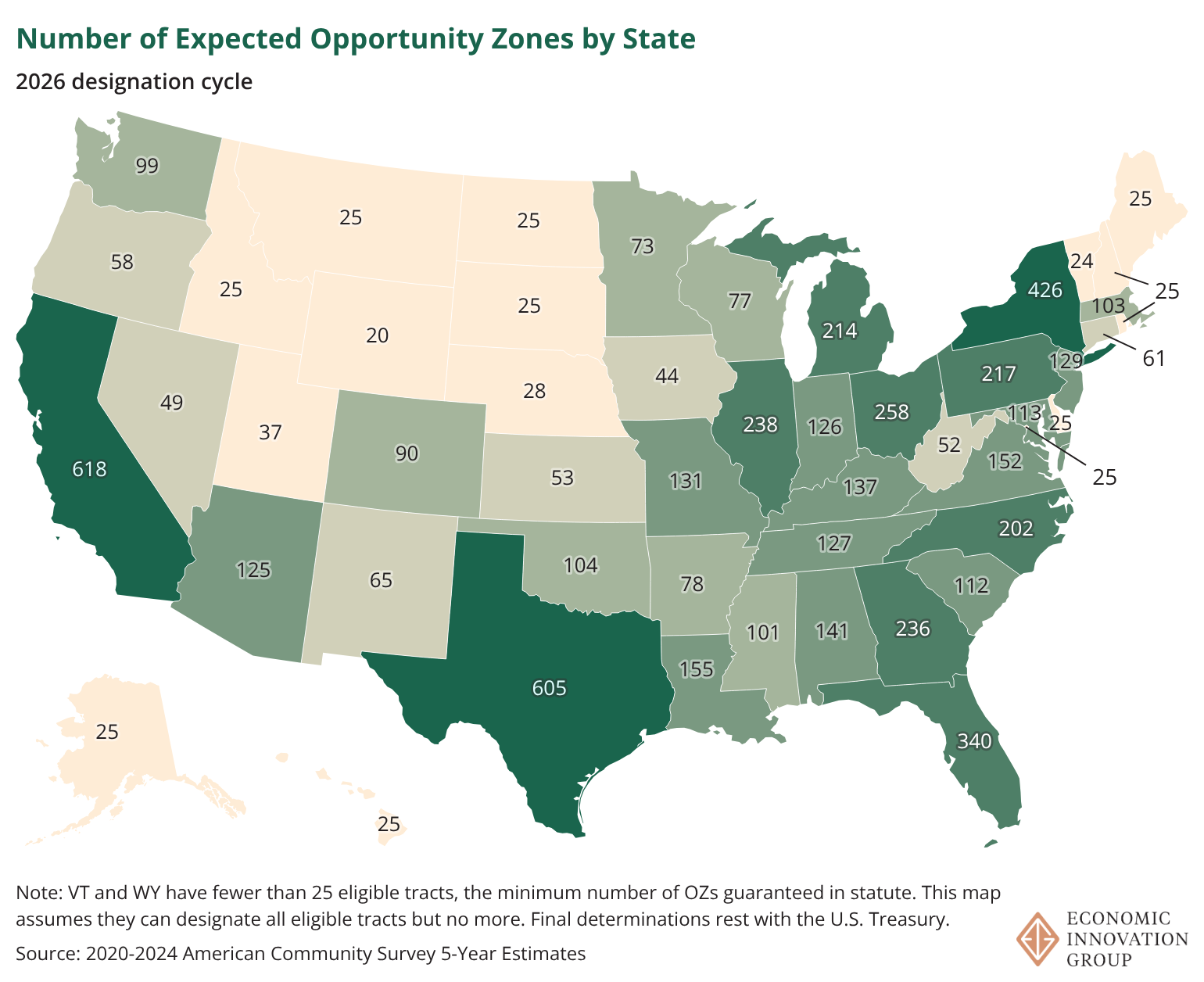
The number of likely designations varies according to a state’s population and economic distress. The most OZs will be found in states with lots of low-income communities — a function of both population size and well-being. California and Texas will lead, with over 600 OZ nominations to make, followed by New York (426), Florida (340), and Ohio (258).
By statute, states are supposed to be guaranteed at least 25 OZ census tracts, but lawmakers did not envision that two states — Vermont and Wyoming — would have fewer than 25 census tracts that meet the new, stricter requirements. The U.S. Treasury will have to weigh in with final determinations on how or whether these two states might be able to make up the shortfall.

Three states — Louisiana, Mississippi, and New Mexico — can expect to nominate more OZs in 2026 than they did in 2018. This reflects the growing economic distress experienced by communities in these states.
Seven small population states — Alaska, Delaware, Hawaii, Montana, North Dakota, South Dakota, and Rhode Island — plus the District of Columbia are subject to the 25-tract minimum and can expect to see no change in their OZ count.
That leaves 40 states preparing to nominate fewer OZ census tracts for the decade ahead than they have currently. Some of these states were hit disproportionately hard by the tightened MFI criteria. Take Minnesota, for example, where poverty is not especially deep but incomes can still lag well behind the state benchmark in rural areas. Its OZ count will fall by 43 percent, more than any other state’s.
EIG is committed to providing state and local leaders with the insights and information they need to make informed decisions during their zone selection process. To stay up to date, sign up for our OZ email newsletter and bookmark this webpage.
In addition to EIG’s interactive map, a full list of census tracts that meet the eligibility criteria based on 2020-2024 ACS data is available for download here.
Notes
- Future Treasury guidance affecting small population states, territories, and tracts with missing data may increase these numbers slightly. This post will be updated as more information becomes available.[↩]