

These stories bring the Distressed Communities Index (DCI) to life and demonstrate how the index can be used to understand the challenges and opportunities that communities face across the United States. These stories are intended to both inform and inspire.
At its heart, the DCI is a tool for exploring the map of American well-being. The stories presented here highlight the many different geographies of economic inequality that traverse the country and explain why they matter, influencing every aspect of life, from the friends one makes to how long one can expect to live.
The gap in life expectancy between prosperous and distressed communities is significant
The economic hardship that defines the typical distressed county exacts a severe human cost. Public health crises like the COVID-19 pandemic and the opioid epidemic disproportionately impact the country’s most vulnerable places. Higher rates of death and disability not only lower life expectancy in distressed communities but also prevent people from fully participating in the economy.
The average resident of a distressed county has a life expectancy of 72 years compared to 79 years for a prosperous county. As a group, distressed counties have less access to healthcare and healthy food options, more deaths of despair, and higher rates of mental illness.
Drug-related deaths per capita in the typical distressed county are more than twice as high as in prosperous counties, and even 1.5 times higher than at risk counties.
Petersburg, Virginia, has a life expectancy on par with many developing countries
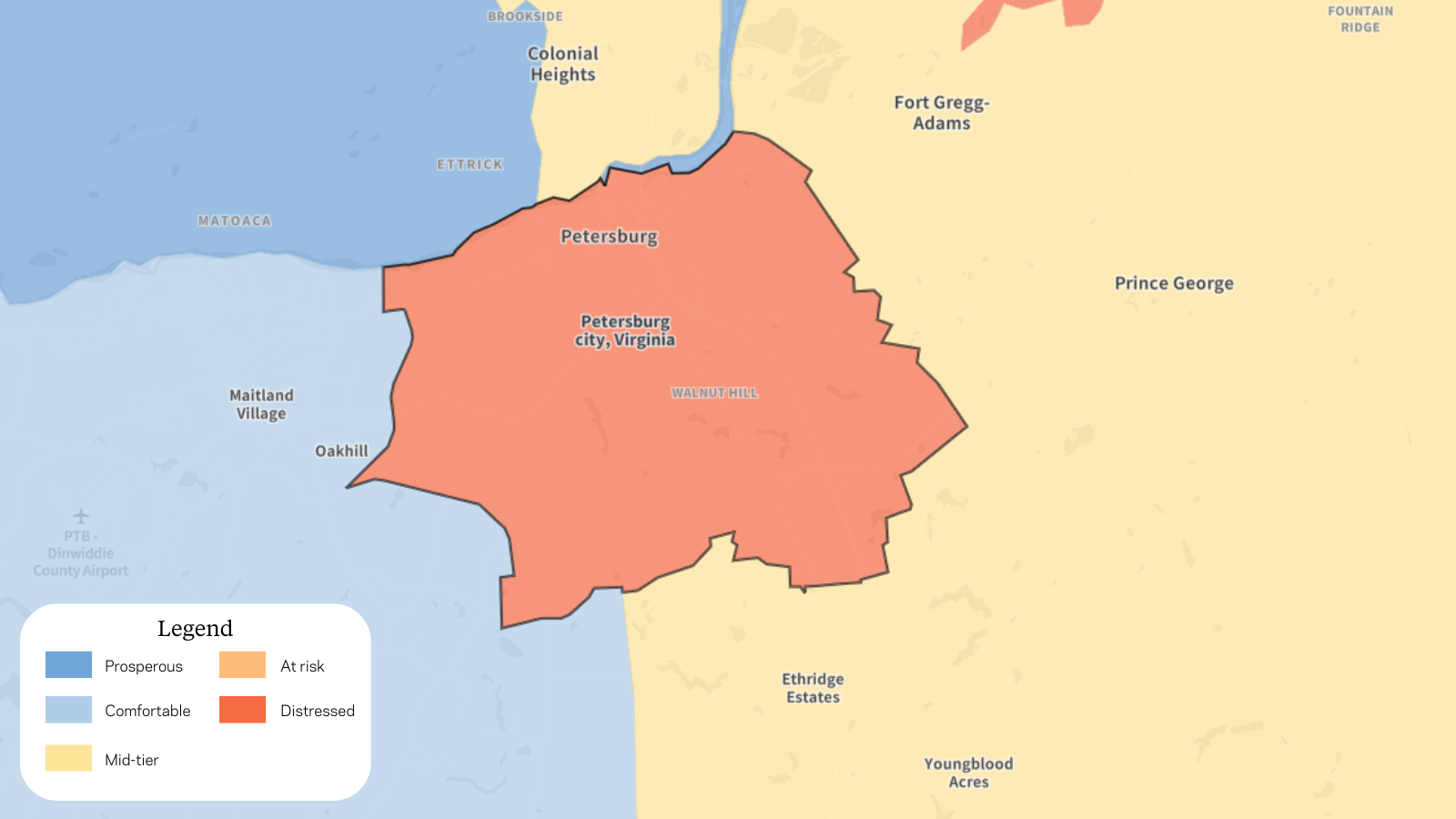
Petersburg, Virginia, has one of the lowest life expectancies among all U.S. counties and the lowest life expectancy of counties with a population of at least 30,000. The average resident only lives 65 years. A substantial 11-year gap separates Petersburg’s life expectancy from the national average, putting the city on par with African countries like Sudan and Ethiopia.

Located just south of Richmond, Virginia, Petersburg is a majority-Black community where 22 percent of residents are below the poverty line, and 17 percent of homes are vacant. A staggering 99 percent of children qualify for free or reduced lunch, over a third live in poverty, and more than half hail from single-parent homes.
There are ongoing efforts to revitalize Petersburg’s historic downtown and create economic opportunities for its residents. However, these statistics, paired with the DCI, reflect a community grappling with concentrated hardship that impacts adults and children alike.
Arlington, Virginia, highlights the link between economic well-being and longevity
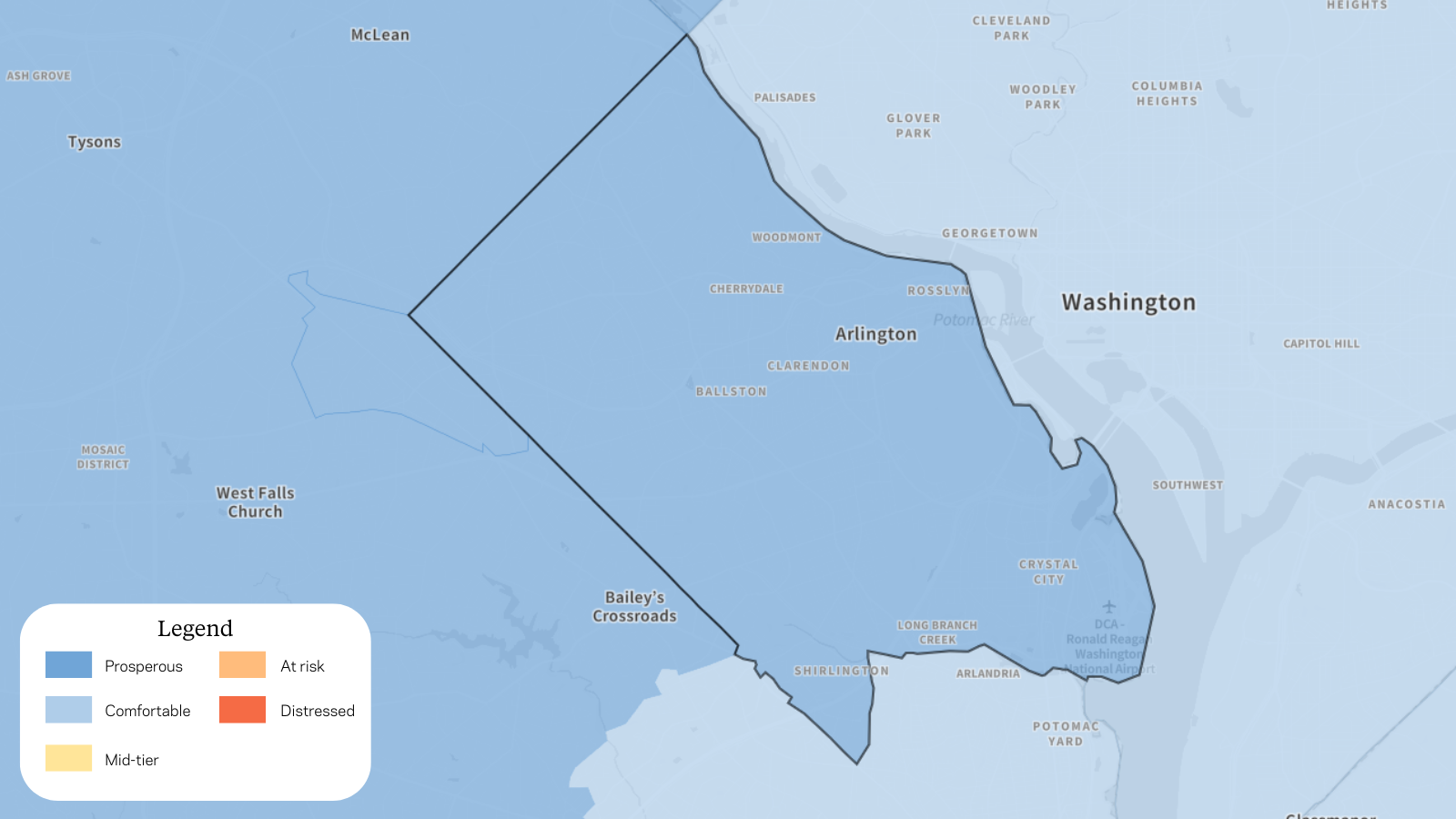
Fewer than two hundred miles north of Petersburg lies Arlington County, Virginia, which has one of the highest life expectancies in the country.
 Life expectancy in Arlington County is 84.7 years, nearly 20 years higher than in Petersburg (and even higher than Sweden). This difference in life expectancy is not just explained by better health outcomes for adults. The infant mortality rate in Arlington is 2.7 per 1,000 births compared to 11.4 in Petersburg.
The median household income in Arlington is a staggering $137,387, and 76 percent of the population holds a college degree. This potent blend of financial security and educational attainment highlights how socioeconomic factors can influence health. Higher education and income levels often correlate with greater social cohesion, healthier lifestyle choices, and better access to quality healthcare.
Appalachia has the highest rates of drug-related deaths
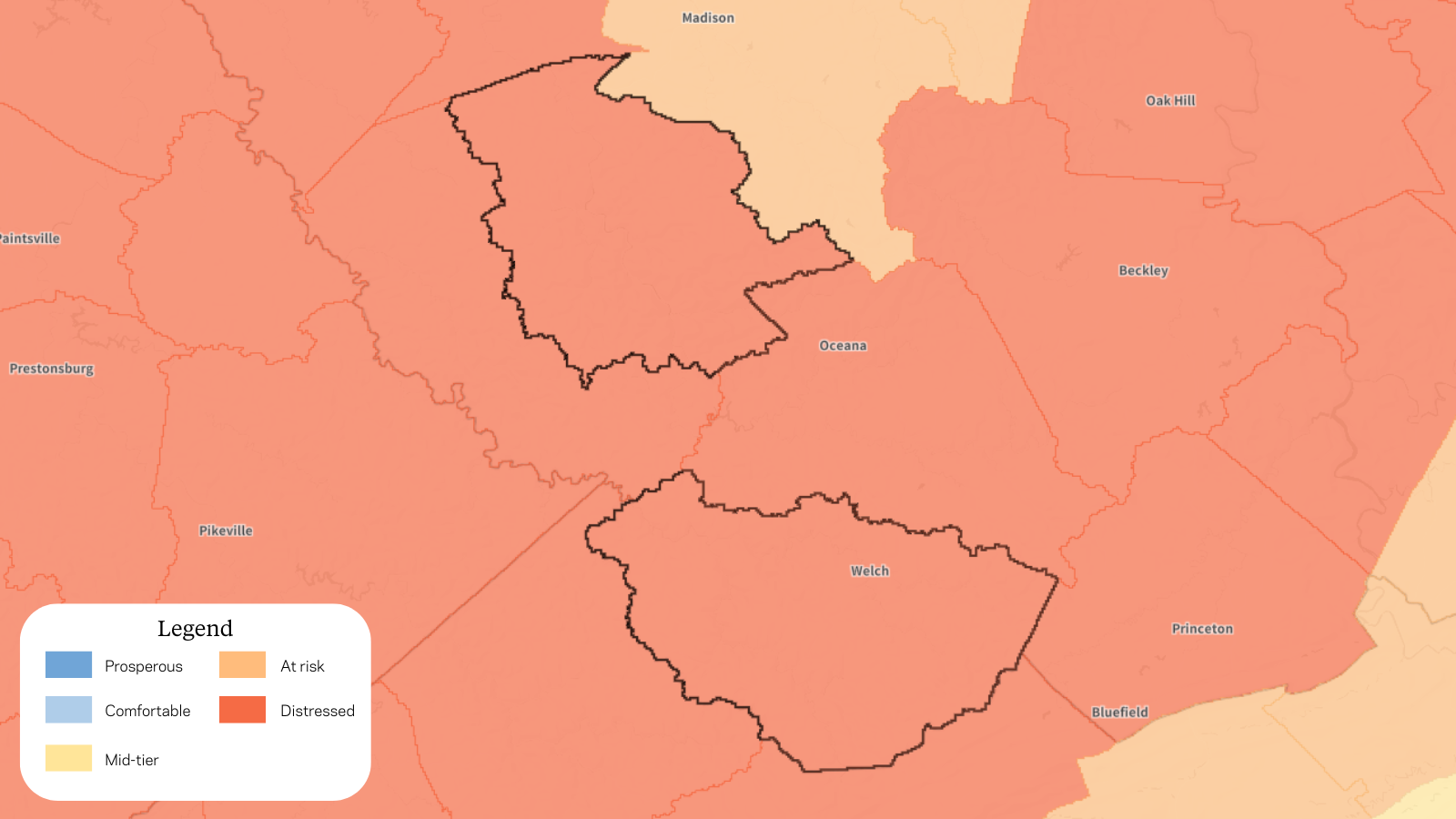
Another couple hundred miles west, the opioid epidemic has ravaged multiple corners of struggling Appalachia. Most of the region is economically distressed and rural, with per capita drug-related deaths well above the national average.
 McDowell and Logan Counties, West Virginia, rank among the ten worst counties in the entire country on drug deaths per capita, with 156.9 and 146.9 drug-related deaths per capita, respectively.
These sobering statistics are inextricably linked to the region’s severe economic hardship. McDowell and Logan are two of the most distressed counties in the country. A staggering 70 percent of prime-age adults in McDowell County are out of work, and Logan County fares little better, with just under half of its prime-age population employed.
The rates of disability among working-age adults in both counties far surpass the national average, pushing many potential workers further from the workforce. Between 2018 and 2022, both counties grappled with declining jobs and businesses, shrinking the pool of available opportunities for residents.
Baltimore’s drug-related deaths are comparable to those in Appalachia

 Baltimore City, Maryland, is the only urban county with drug-related deaths per capita comparable to rates in rural Appalachia. It had a total of 800 deaths in 2022, or 140.4 deaths per 100,000 residents. To put this in perspective, Baltimore’s population is only one-third that of Wayne County (Detroit), yet its per capita death rate is three times higher.
Baltimore grapples with significant economic and social challenges. Nearly one-quarter of its prime-age residents are unemployed, and the city has witnessed a steady decline in both businesses and population. This economic hardship is compounded by one of the nation’s highest homicide rates. Nearly two-thirds of its population identifies as Black, a stark demographic contrast to the primarily white populations found in the Appalachian counties.
Prosperous, exurban counties tend to have few drug-related deaths

Among counties with exceptionally low drug-related death rates in 2022, Fort Bend County, Texas, is one of the largest in population.
 Home to roughly 830,000 residents, this affluent Houston suburb saw only 114 such deaths in 2022 (12.8 deaths per capita), a rate significantly lower than Baltimore’s.
While non-Hispanic white residents remain the county’s largest group at 30 percent, Fort Bend has sizable Hispanic (25 percent) and Black (20 percent) communities. Notably, nearly half of the county’s residents have a Bachelor’s degree, and nearly one-third are foreign-born. Furthermore, its median household income surpasses the surrounding metro area by 40 percent, highlighting its significant economic strength.
The DCI reveals how health and economic distress are linked
A crosswalk of drug-related deaths and life expectancy clearly shows how economic distress is closely correlated with poor health and premature death. The link between economic distress and poor health outcomes is further underscored by health researchers’ use of the DCI. Studies leveraging the DCI have revealed associations between economic distress and higher rates of mortality after cardiac surgery, death from liver disease, and certain types of cancer.
Data source: EIG analysis of CDC Wonder data and the University of Wisconsin Population Health Institute.