
These stories bring the Distressed Communities Index (DCI) to life and demonstrate how the index can be used to understand the challenges and opportunities that communities face across the United States. These stories are intended to both inform and inspire.
At its heart, the DCI is a tool for exploring the map of American well-being. The stories presented here highlight the many different geographies of economic inequality that traverse the country and explain why they matter, influencing every aspect of life, from the friends one makes to how long one can expect to live.
Friendships between social classes are rare in distressed communities
Social capital, the network of connections, shared norms, and trust woven between people, fosters community and collective prosperity. It can be broken down into two core types: bonding capital, which links individuals within groups, and bridging capital, which connects people across divisions such as race, class, and education. Bridging capital can open doors to career opportunities and educational pathways, ultimately fostering upward mobility.
The quantity and quality of social capital varies tremendously across neighborhoods. A novel dataset compiled by Raj Chetty and researchers at Opportunity Insights measures bridging capital with an economic connectedness index. The index uses zip code-level data on 21 billion Facebook friendships to quantify the degree to which people from lower socioeconomic status (SES) develop friendships with higher SES. A value of 0 indicates no friendships across the SES median, while a value of 1 suggests that low-SES individuals have an equal number of high- and low-SES friends.
The Distressed Communities Index (DCI) reveals a harsh truth: economic hardship erodes social connections, leaving distressed communities with far fewer bridges across social divides. In total, 21.7 million individuals live in a zip code that is both distressed and in the lowest decile for economic connectedness—45 percent of the total population in distressed communities. By contrast, a vanishingly small share of residents in prosperous and comfortable communities live in areas with weak social connections.
The nation’s capital has high rates of economic connectedness
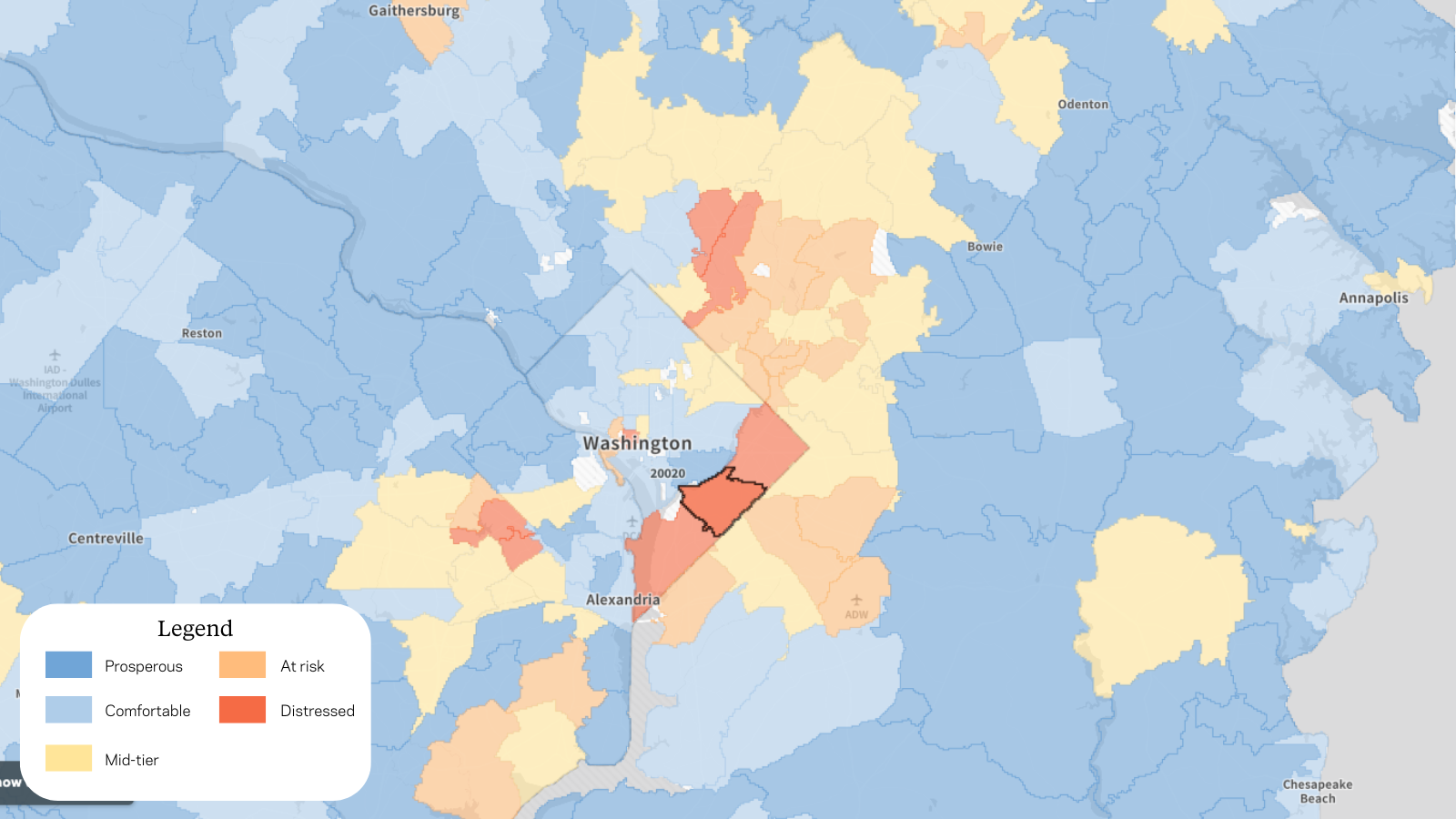
 In contrast to most other American cities, all five of the nation’s capital’s distressed and at-risk zip codes score highly on economic connectedness.
For instance, the city’s Anacostia neighborhood is ranked as distressed by the DCI but has an economic connectedness value of 0.92, slightly above the average for all zip codes.
The DC region has one of the country’s only prosperous and majority-Black counties

 The surprisingly robust social connections between residents of DC’s struggling areas and those of higher socioeconomic status might be explained by the proximity of Prince George’s County, Maryland. This county is notable for being one of the few predominantly Black counties in the U.S. that ranks as comfortable on the Distressed Communities Index, with no majority-Black counties reaching prosperous status. DC’s mainly Black, economically challenged zip codes, isolated from other parts of the city by the Anacostia River, may have developed stronger social and economic bonds across the county line instead. The shared racial background could potentially foster economic linkages between these distressed DC neighborhoods and the more affluent communities in Prince George’s County.
Low economic connectedness prevails across Houston’s expanse of distressed zip codes

Houston, Texas has one of the largest urban expanses of distressed zip codes with very low economic connectedness among metro areas, although it is far from an outlier. Thirty-six Houston zip codes housing 1.1 million residents fall into the distress quintile and rate 0.7 or lower on economic connectedness. This concentration of economic hardship isolates residents and deprives them of the bridging social capital that could pave the way to upward mobility.
Eastex-Jensen is one of the most struggling neighborhoods in Houston

 The Eastex-Jensen neighborhood lies at the heart of Houston’s cluster of economic distress and low connectedness. Half the population of this majority-Hispanic zip code wedged between two highways lacks a high school diploma, and the poverty rate is three times the national rate. A third of its residents are foreign-born. The zip code’s economic connectedness value is 0.48, significantly below the average for distressed zip codes.
The Minneapolis metro combines prosperity with high economic connectedness

At the other end of the spectrum, economic connectedness runs especially high in the prosperous areas of the upper Midwest–traditionally the country’s social capital heartland.
The Minneapolis metropolitan area has the largest cluster of prosperous zip codes with an above-average economic connectedness value. The suburban zip codes that ring the urban core have an average economic connectedness value of 1.2, indicating a high degree of connection between low- and high-SES individuals. In this cluster’s typical zip code, the median household income stands at $101,700, and 42 percent of the population holds a bachelor’s degree or higher.
The metropolitan area’s distressed zip codes also have high levels of economic connectedness, suggesting that the region may benefit from social capital spillovers across its economic and demographic divides.
Economic connections matter for achieving the American dream
Neighborhoods shape the lifetime outcomes of those who pass through them, especially children. Economic connectedness can help individuals from limited means overcome the disadvantages of place and realize their version of the American Dream. While connectedness is highly correlated with well-being at the neighborhood level, a few distressed communities stand out for offering especially strong social capital. These places may hold lessons for anyone interested in building more ladders of opportunity in communities across the United States.
Data source: EIG analysis of Opportunity Insights data.